

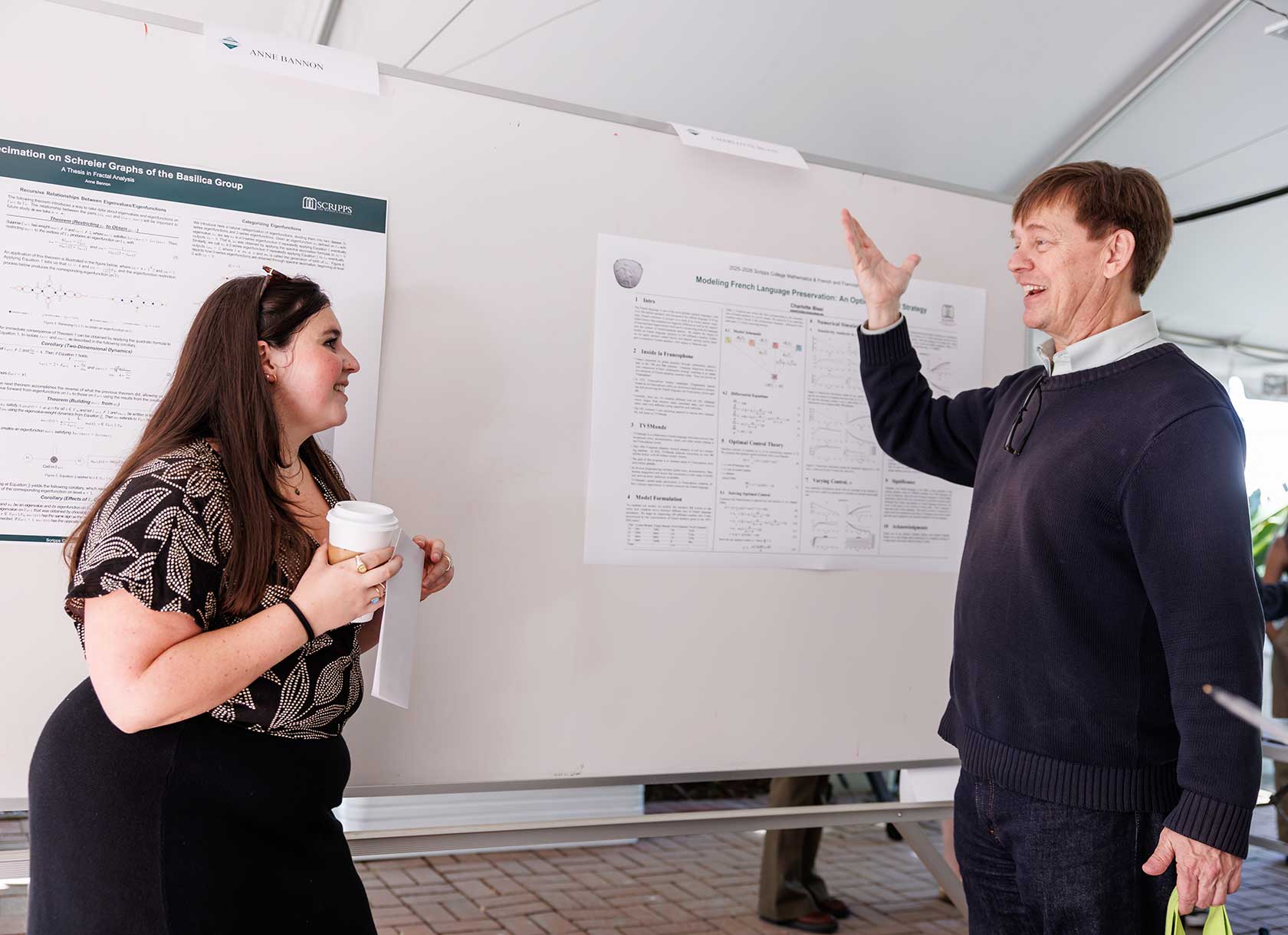
 Chalotte Blasi ’26 and Professor of Mathematics Chris Towse
By Caitlin Antonios
- Scripps students showcased months of independent research and interdisciplinary collaboration during Capstone Day, presenting senior theses that reflected the skills and passions they developed throughout college.
- Several projects tackled meaningful social and cultural issues across disciplines, including math, psychology, art, and more.
- Faculty praised the confidence and growth of student researchers, with Capstone Day continuing to serve as one of the college’s most celebrated academic traditions.
After months of sleepless nights and eye-straining research, Scripps graduates celebrated the culmination of their senior theses with staff, faculty, and peers at Capstone Day.
At Scripps, every student must complete a thesis prior to graduation. Working closely with two faculty advisors, students often begin working on their project in their junior year or even earlier. The process varies by major but requires rigorous independent research and collaboration that leads to a substantial written, creative, or scientific project that demonstrates the skills students developed throughout college.
Interdisciplinary work on display
Charlotte Blasi ’26, a dual math and French major, constructed her thesis by drawing on her favorite components of each subject. Her thesis, “Modeling French Language Preservation: An Example of Optimal Control Strategy,” examined the global spread of the French language through media efforts, the nation’s imperialist history, and a model for language preservation.
While French is not currently an endangered language, UNESCO cites 2,500 languages as “vulnerable.” Blasi says her model can be more broadly applied to protect threatened tongues from disappearing.
“I loved using this research to construct my own mathematical model, building upon concepts I’d learned in my math classes,” Blasi says. “We have the resources to preserve these endangered languages, we just have to think more deeply about the framework.”
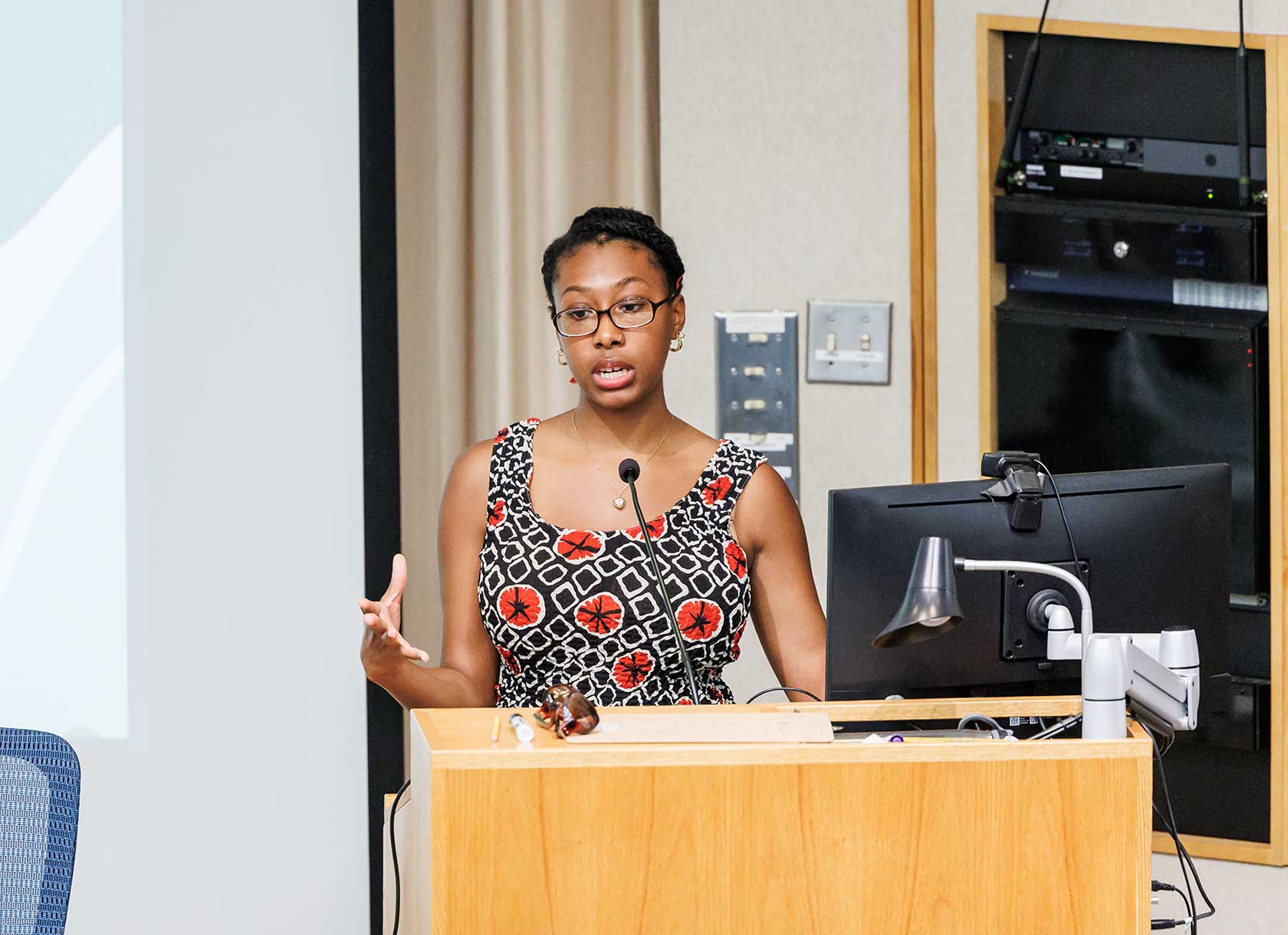 Hannah McKie ’26
Filling in the gaps
For some students, their research is deeply personal. Hannah McKie ’26, a psychology major with a minor in music and Africana studies, focused on the role gendered racial identity plays in the “angry Black woman” stereotype. Her thesis aimed to address a gap in psychological research on Black women that she noticed during her time as an undergraduate—work she plans to pursue beyond her time at Scripps.
“Getting the opportunity to design and carry out research aimed at understanding and improving the lived experiences of Black women and other marginalized groups was incredibly meaningful for me,” McKie says.
Kaya Rae Savelson ’26, an art major who minored in German studies, also plans to continue their thesis project after they graduate. The project, “Bounds of Expression,” examined gender and expression in a display at the Ruth Chandler Williamson Gallery.
Part of the piece hung from the ceiling, allowing the viewer to move around it to observe.
“It’s fragmentation is a physical representation of gender constantly in flux,” Savelson says.
 Kaya Rae Savelson ’26
While most students who present at Capstone Day are seniors, some students who double-major opt to complete at least one thesis their junior year.
Han Na Shin ’27, a physics and math double major, presented her math thesis as a junior during Capstone Day. She began her research as a sophomore, working with Professor Konrad Aguilar at Pomona College to look at the math structure of quantum physics, which she was drawn to because of her interest in condensed matter physics. She has interned somewhere different each summer, including with the Department of Natural Sciences of Pitzer and Scripps Colleges, USC, and CalTech, to further explore her interests within the field.
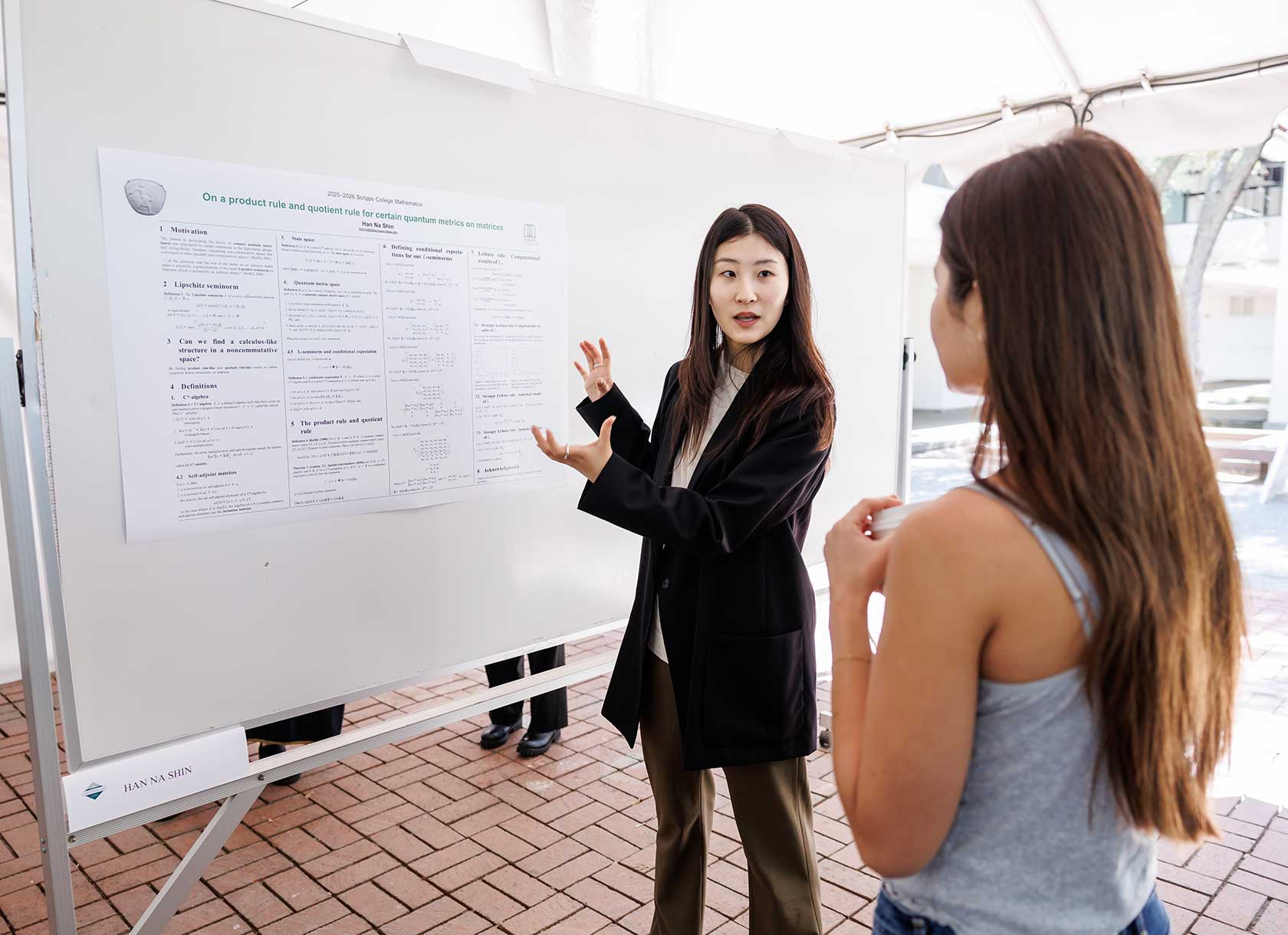 Han Na Shin ’27
“I found my passion for it by exposure to different things,” Shin says. “Sometimes I hit a wall, but that’s okay because that still teaches me about what I don’t like.”
Jam-packed with multiple presentation sessions per hour, Capstone Day continues to draw a crowd each year. It remains one of the most meaningful events for Scripps’ academic community.
“It’s amazingly fun to see the wide variety of topics,” Professor of Mathematics Chris Towse says. “I had most of these students as first-years in calculus, and now they’re presenting on topics beyond my area of study and do so with confidence. My goal is for them to be really proud of their work and in five years say, ‘I can’t believe I did that.’”