

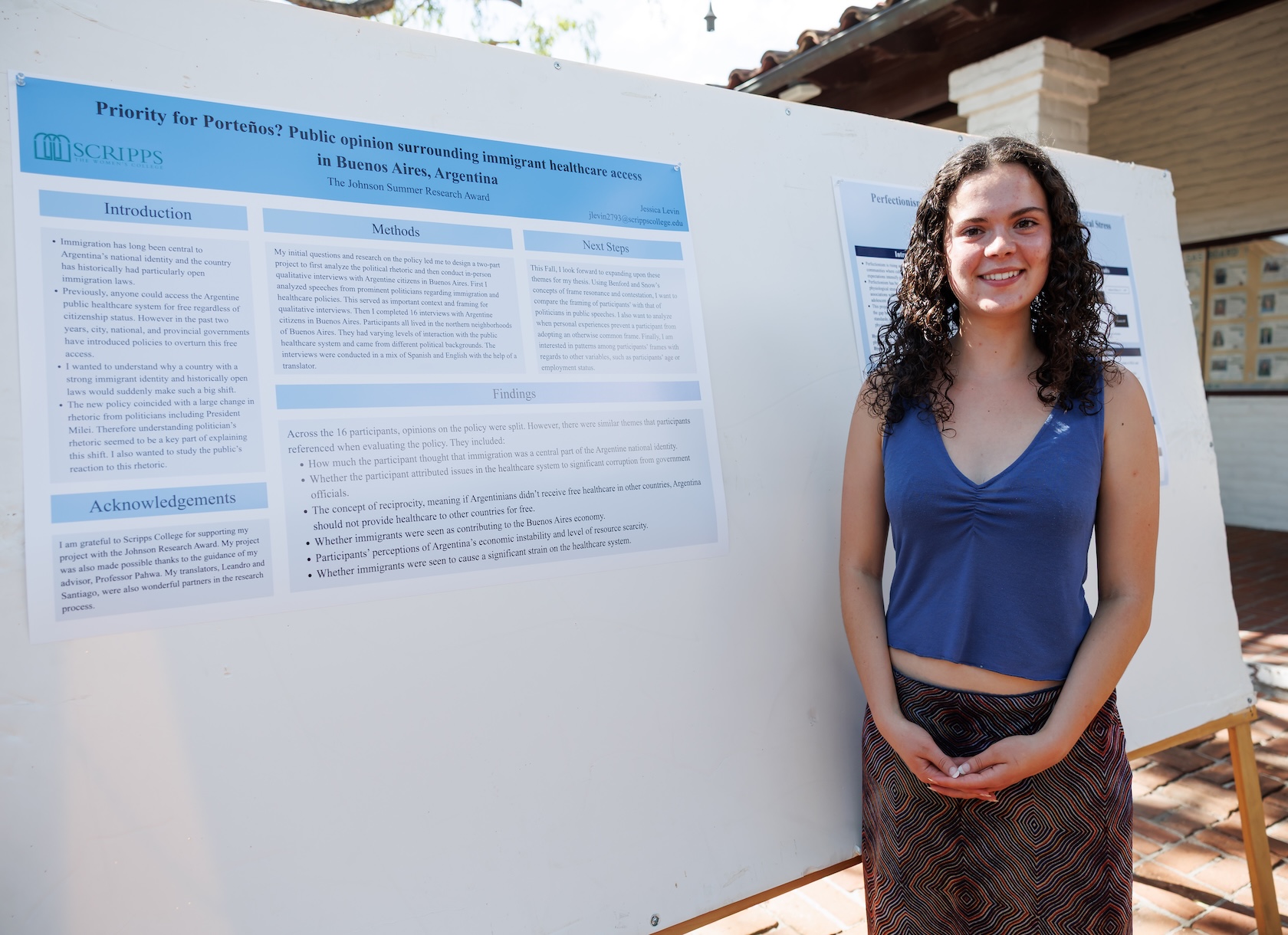
Jessica Levin ’27
By Kendra Pintor and Caitlin Antonios
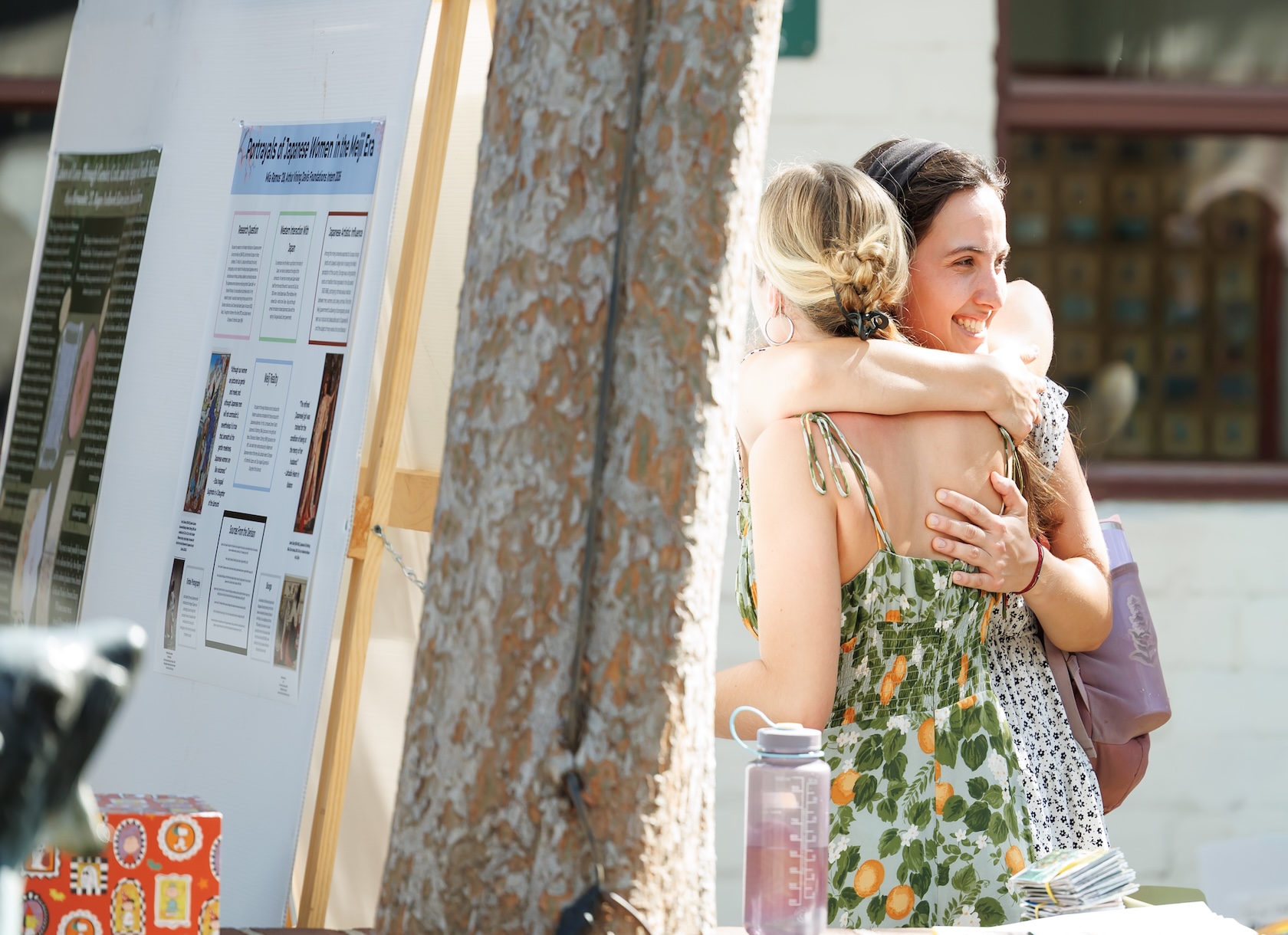
The annual Research Tea celebrates Scripps students’ summer research projects and the faculty mentors who support them, highlighting the College’s interdisciplinary culture of curiosity and inquiry. Featured students Jessica Levin ’27, Lizzie Clark ’27, Alyssa Hernandez ’27 and Malin Moeller ’27 share how their research—from political rhetoric and neuroscience to needlework history and 19th-century banking records—has allowed them to explore their academic interests beyond the classroom.
For Scripps College students, undergraduate research can begin with a question that does not have an easy answer: How do governments serve their people? What happens in the brain when we make decisions? How do our experiences shape the way we understand ourselves and the world around us?
Interdisciplinary Research at Scripps
For students such as Jessica Levin ’27 and Lizzie Clark ’27, those questions have led to research experiences that reach well beyond the classroom and into communities, laboratories, and new fields of inquiry.
Levin, a data science and politics major, traveled to Buenos Aires, Argentina to examine political rhetoric surrounding immigrant access to health care. Her project explored how politicians talk about changes to health-care access—and how citizens respond to those conversations.
“What I found personally interesting about asking these questions was thinking about how citizens view their governments and what obligations governments have to their people,” Levin says. “It’s hard to make direct comparisons between Argentina and the United States because the political contexts are so different, but there were things that surprised me. I saw a lot of different political ideologies reflected in the ways people talked about these issues.”
That kind of interdisciplinary inquiry is also at the heart of Clark’s research. A neuroscience major with a dance minor, Clark studied executive function and brain activity in children, investigating whether acute moderate-to-vigorous physical activity can improve executive function while considering factors including exercise consistency, gender, and weight status.
Her research uses electroencephalography (EEG) to measure electrical activity in the brain. The resulting event-related potentials, or ERPs, allow researchers to observe patterns of neural activity as participants respond—or choose not to respond—to different stimuli.
“For me, the most interesting thing is looking at the waveforms, because you can follow the highs and lows of a person’s brain as they choose to respond or not respond,” Clark says. “Each kid, regardless of their variables, has the same ERPs. It’s something that makes us human, and seeing the neural activity that connects us all is super interesting. Across people—and even across species—we can see these neural patterns.”
Clark’s interest in the intersection of movement and the brain grew naturally from her background as a dancer.
“I originally wanted to see how dance impacts brain activity and development,” she says. “So, I joined a lab that was a mix of laboratory research and neuroscience.”
Her experience illustrates how students can bring seemingly different interests together to develop new questions. For Clark, dance provided a starting point for exploring the science of movement and cognition. For Levin, data science offered a new lens through which to examine political behavior and public policy.
Their projects are vastly different in subject matter, methodology and setting, yet each reflects the value of undergraduate research: the opportunity for students to pursue questions driven by their own curiosity and to discover where those questions can lead.
The Scripps Difference
At Scripps, approximately two thirds of students pursue more than one area of study. This is a testimony to the College’s commitment to creating a culture of curiosity and exploration and to being a place where students can dare to pursue opportunities that can transform their future.
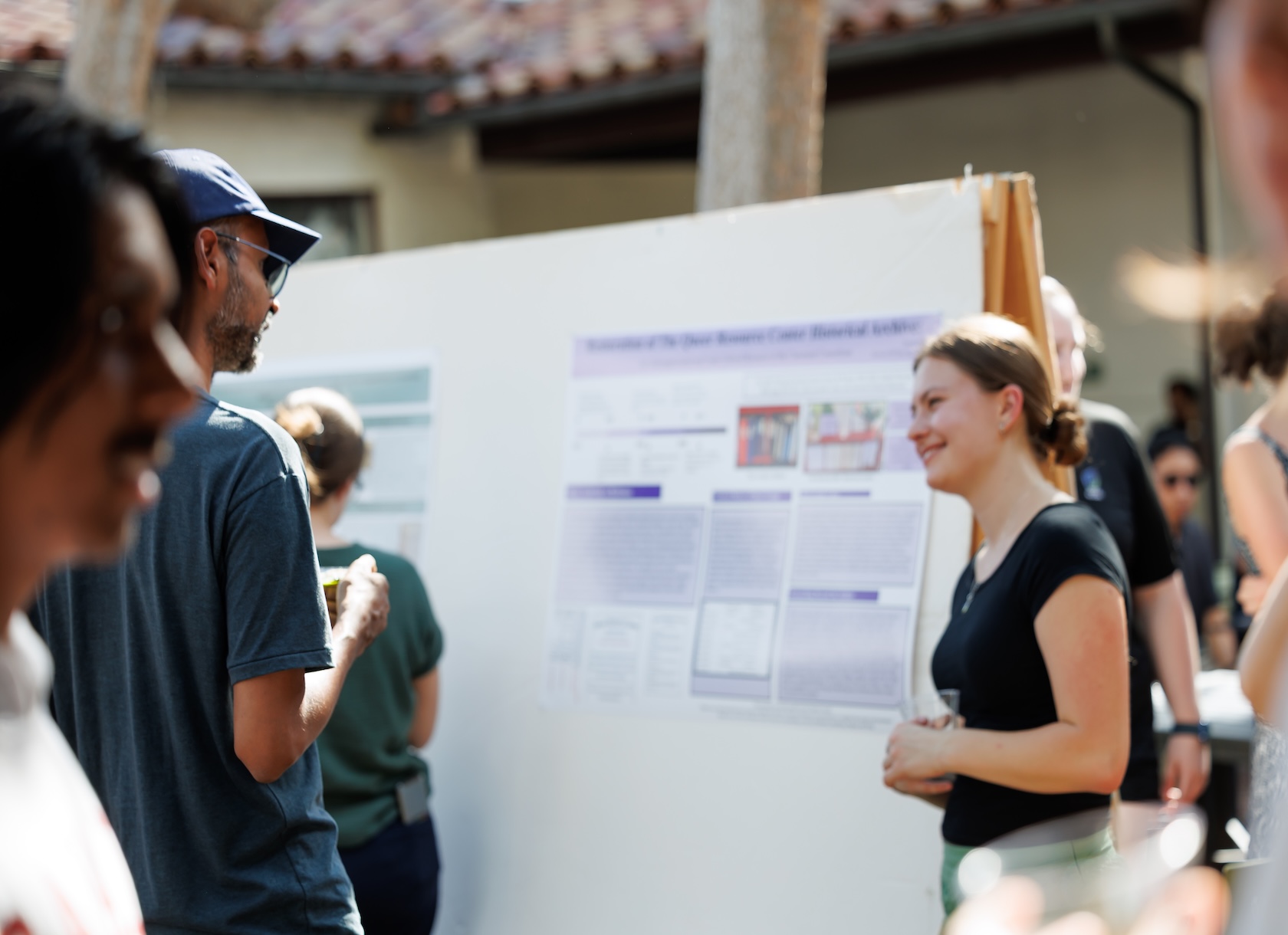
“The Research Tea is one of the most meaningful traditions we have for celebrating our students’ summer research projects, as well as their faculty mentors,” says Associate Dean of Faculty Warren Liu. “Every fall, the event gives students the opportunity to share their central research questions, explain the methodologies that informed their project, and highlight the discoveries made possible through their work.
“The sheer variety of projects is also a wonderful reminder that research at Scripps is not confined to one field or one mode of inquiry—it is a deeply interdisciplinary practice rooted in curiosity, creativity, and mentorship.”
At Scripps, Students are Free to…
Alyssa Hernandez ’27 first encountered the Gay Ann Rogers ’65 Needlework Collection up close in spring 2026, when she visited Denison Library with Professor of Art Kim-Trang Tran’s computational textiles class. Artifacts from the 1930s were laid out for students to examine, and Hernandez immediately saw how the collection brought together the two fields she was pursuing: art and politics.
“I’ve always been really interested in the use of art as a way to convey narrative and history,” Hernandez says. “This was an example of how women’s work inside the household, which was often invisible labor, allowed women to record their own stories.”
Hernandez went on to apply for the Rogers Needlework History Internship at Denison, where she gained hands-on experience working with the artifacts. Her research focused largely on handkerchiefs and the ways their meaning shifted over time.
“From the 1940s through the ’60s, handkerchiefs were very multi-purpose, but they initially started as a purely decorative art that then shifted to utility,” Hernandez says.
Another student combining interdisciplinary study with summer research is Malin Moeller ’27. A history and economics dual major, Moeller spent the summer working with Assistant Professor of Economics Patrick Van Horn to review and transcribe Union Bank’s handwritten dividend records from 1806 to 1814.
Funded by the Johnson Summer Research Grant, Moeller plans to continue the work for her senior thesis. The archival project revealed a more varied financial landscape than she expected.
“I was surprised to see that access to bank stock wasn’t limited to just aristocracy in this time period,” Moeller says. “There were institutions and smaller businesses, like mechanics, that had access to investments and opportunities.”
Whether examining political debates about health-care access halfway around the world, tracing patterns of electrical activity in a child’s brain, uncovering women’s histories through needlework or transcribing centuries-old dividend records, Scripps students are free to engage with complex questions—and, in the process, developing the skills to become thoughtful scholars, researchers and citizens.
Give Today! Through Scripps Forward: The Centennial Campaign for Scripps College, we aim to surpass $100 million in donor support over three years and secure a future of infinite possibility for the next century. Your generosity helps talented students fully engage in Scripps’ academic and co-curricular life.