

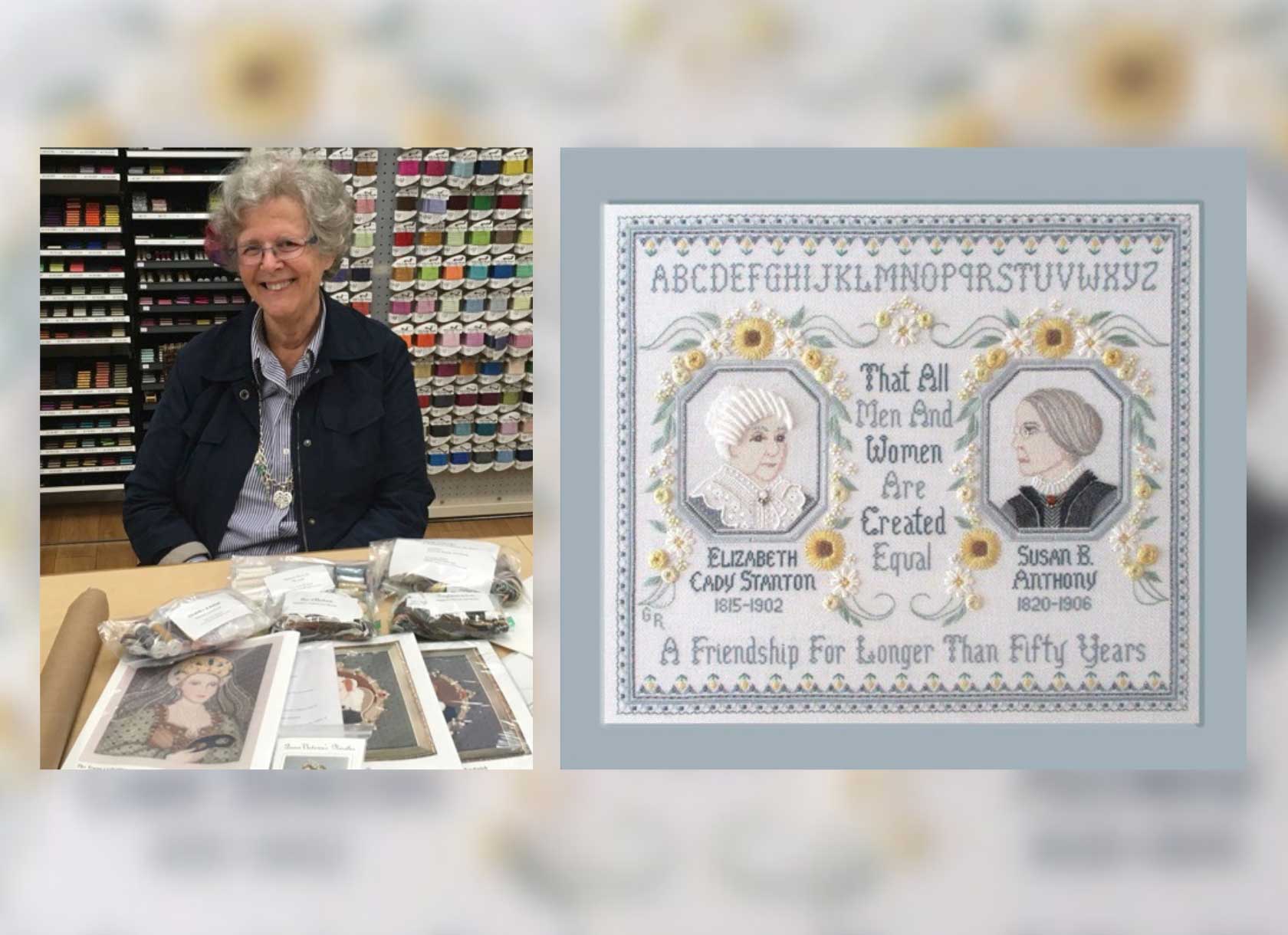
by Kendra Pintor
- From defying expectations after graduation to building a decades-long career in needlework, Gay Ann Rogers’ story weaves together art, storytelling, and the preservation of women’s labor through her transformative collection at Scripps College.
When Gay Ann Rogers graduated from Scripps College in 1965, she believed she had failed at what she had been told was her “most important task”: find a husband. “Enormous failure indeed,” Rogers recalls with characteristic humor. Her mother instructed her to return home to remedy that.
Rogers said no.
Instead, she remained in Claremont to continue her education at Claremont Graduate University and began teaching high school English. Two years later—on her own terms—she married Jim Rogers, a history professor at Claremont McKenna College. Their partnership, she says, profoundly shaped the way she sees the world and her decades-spanning career as a needlework designer, educator, and collector.
A family legacy of education and art also influenced Roger’s path to Scripps. Her mother was an alumna and her father, who attended Caltech, encouraged her to attend the College. A literature major, Rogers did not yet know that storytelling—so central to her academic experience—would become a defining feature of her needlework designs.
“Literature has played a huge part in the way I have approached needlework,” she says. “It’s always been about narrative for me.”
This connection between storytelling and art can be traced back to Rogers’ childhood in the Seattle area, where she spent summers knitting ski sweaters and growing up in a family that valued making and collecting. “My mother and both of my grandmothers were collectors,” Rogers explains. “They encouraged me to gather things related to stitching. I began with needlework tools and never really stopped.”
Her professional life in needlework began, as she puts it, entirely by accident. While shopping for yarn to knit a sweater, she wandered into a store and asked why some of the yarn had been cut. The shop owners explained it was for needlepoint, showing her canvas and materials unfamiliar to her at the time. Curious, Rogers took some supplies home, created a few pieces, and returned to the shop.
“They sold in a day,” she says. The shop asked for more, and what began as casual experimentation unraveled into a more than 50-year career.
Over the next decades, Rogers taught needlepoint around the country, traveling constantly. “For 25 years I spent my life racing across the Dallas airport to make flight connections,” she recalls. “Those years of travel led me to expand my collections and deepen my understanding of the techniques I was teaching.”
After her students asked for the craft’s context, Rogers began collecting historic examples of needlework and objects that illuminate women’s domestic lives, such as 19th century pincushions from France and the East India Company. She has also preserved needlework tools, lace, and whitework from the era of Jane Austen. “Her novels and letters to her sister are full of references to needlework and lace,” Rogers notes. “She herself was an enthusiastic needlewoman—she evidently excelled at satin stitch.”
Celebrating Women’s Labor—Needlework Lives on at Denison Library
For the last eight years, Rogers has been donating her impressive and expansive collection to the Ella Strong Denison Library at Scripps.
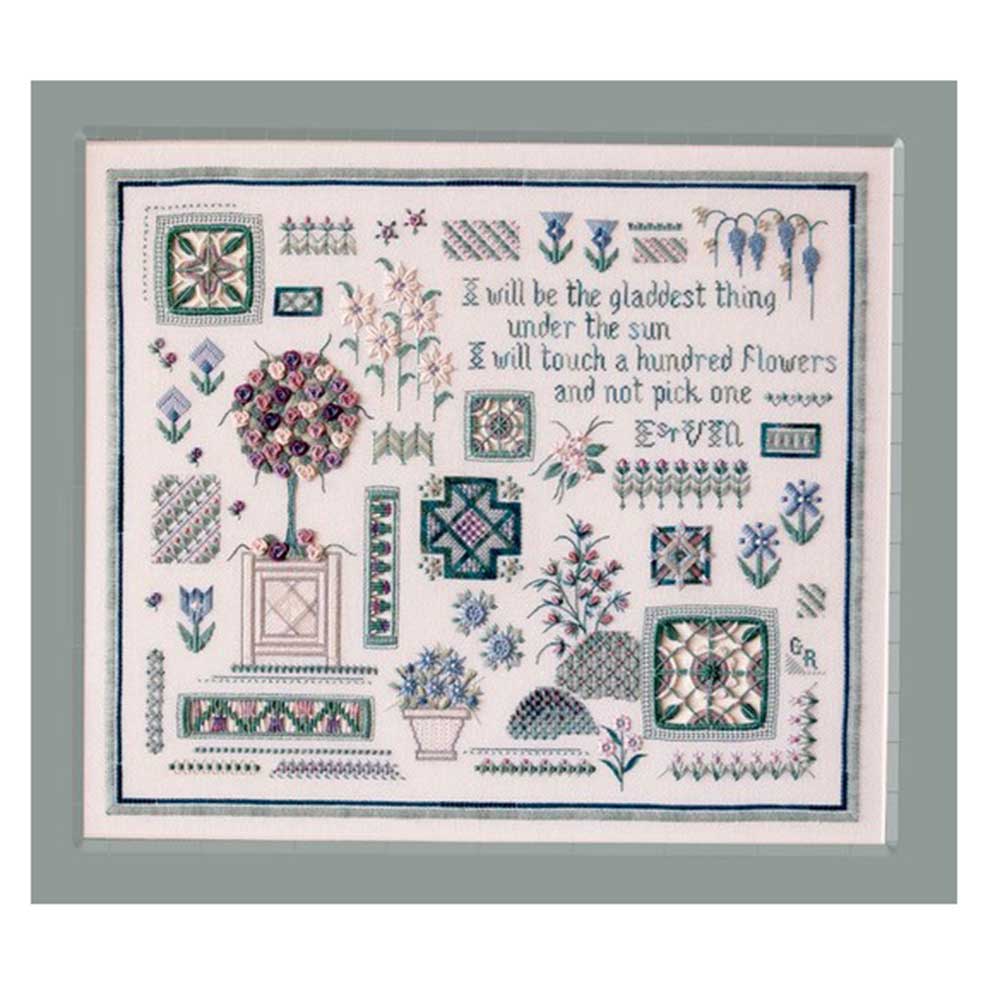
Title: From Edna St. Vincent Millay, “I will be the gladdest thing under the sun, I will touch a hundred flowers and not pick one.”
“The Rogers Collection shows how the legacy, culture, and economic realities of women’s needlework are interwoven across centuries and sociopolitical boundaries,” says Jennifer Martinez Wormser ’95, director and Sally Preston Swan Librarian for Denison Library. “Its breadth demonstrates the design and development of these specialized tools alongside guides, printed instructions, and the finished products themselves.”
For Grace Valashinas ’26, a foreign languages major concentrating in Spanish and French, working with the collection has meant encountering these histories firsthand.
“While the writing and research skills from my major have certainly been relevant in this role, what drew me to the collection was actually my extracurricular interest in needlework,” says Valashinas, who has worked in the costume shop at Pomona College since her first semester. “I wanted to share my love for the history of needlework and sewing with the wider Claremont community.”
Over the summer, she organized the collection, photographed objects, and researched their histories. As the work has continued into the academic year, she has begun processing new donations and developing programming to bring the collection to a wider audience.
“What stood out to me most was the history behind the items,” she says. “Each tool represents what millions of people around the world have used every day for decades or even centuries to generate income for their families, brighten their homes, or mend their children’s clothes.”
That realization reshaped her understanding of the craft. “While in the United States today we often think of needlework as a hobby, it has been a means of survival for so many people, especially women,” Valashinas says. “You cannot separate women and their labor from the practice of needlework.”
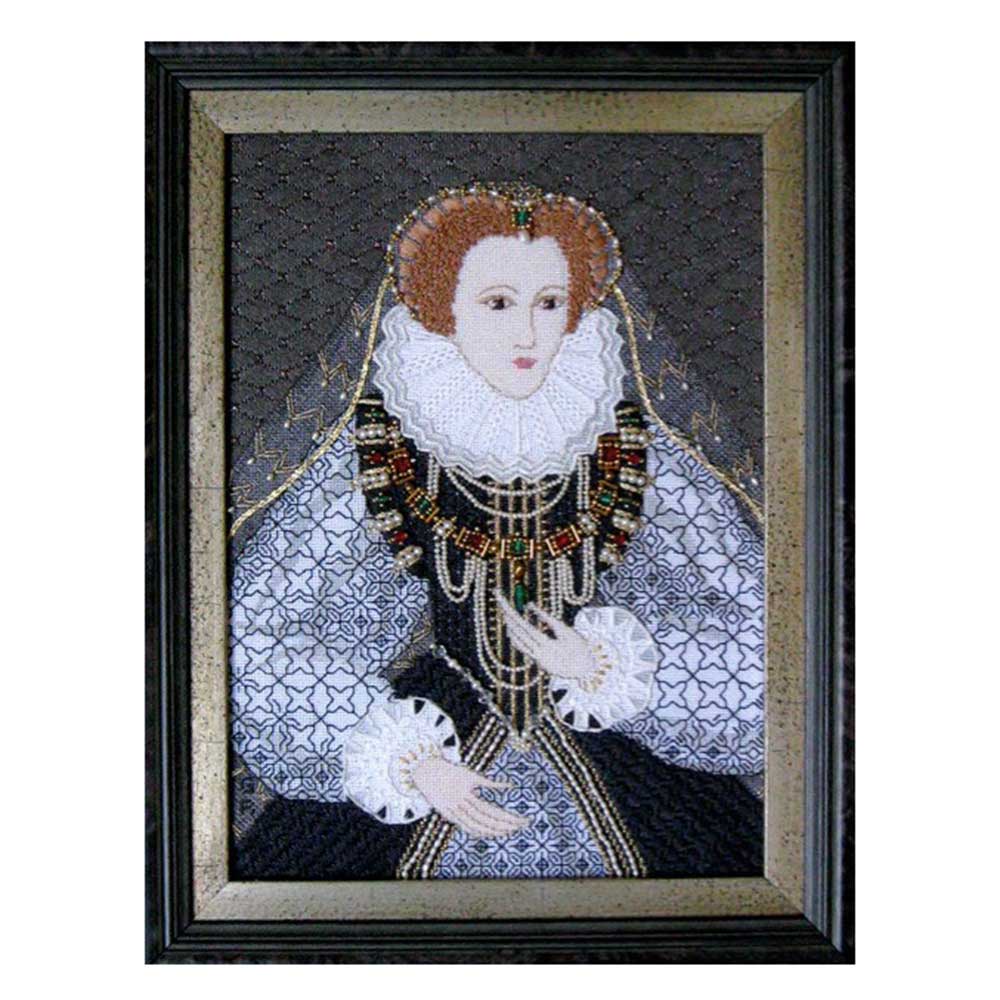
Title: Elizabeth I In Her Youth
Even beyond its economic function, she adds, needlework carries stories across generations. “It is a crucial means of survival in its storytelling capacity,” says Valashinas, who has recently been researching Native American embroidery. “It’s so important to recognize the ways historically underrepresented communities—women, Indigenous people, and many others—use these skills to tell their stories, continue centuries-long traditions, and bring people together.”
Weaving Needlework and Women’s Liberation
Throughout her career, Rogers has navigated shifting cultural attitudes toward needlework and feminism. Early on, she encountered resistance. At a local feminist meeting attended with fellow faculty wives, Rogers introduced herself as a needlework artist—and was promptly asked to leave.
Later, she found a different kind of affirmation through the Needlework Guild, whose members embraced the practice as meaningful, self-directed labor. “We steal this time for ourselves,” Rogers recalls their ethos. “It’s important to us, and we don’t care what anyone thinks of it.”
Decades later, during the COVID-19 pandemic, Rogers witnessed yet another evolution. Through a Zoom-based needlework group organized by younger feminists and queer artists, she saw renewed interest in traditional techniques like cross-stitch—not as nostalgia, but as reclamation.
“This is women’s work and women’s art,” she says. “Anonymous women’s expression matters.”
Now, as Rogers donates pieces of her needlework collection to Scripps College, she sees the gesture as an invitation—to students, scholars, and the broader community—to engage with needlework as both art and historical record. “I want to share my little world,” she says simply.
“In 2023 we had a wonderful exhibit of Rogers’ collection, curated by Sage Wong Davies ’25, titled Through the Eye of a Needle,” says Wormser. “We hope to have another in the coming year or two.”
As Scripps considers the collection’s resonance with Denison Library and the College’s long-standing commitment to feminist inquiry, Rogers’ work offers something rare: material evidence of women’s creativity, labor, and intellectual life across centuries. In thread and lace, her story—and the stories of countless unnamed women—continue to unfold, now in conversation with a new generation of scholars and makers.
“Gay Ann’s connoisseurship of the field and its history have provided Scripps with a dynamic and unique archival collection that is multimodal and interdisciplinary,” says Wormser. “It is a perfect match for our curriculum and the learning opportunities we provide here at Scripps College.”
To support student research, please make a gift to Denison Library here.