

Get a behind-the-scenes look on the writing and rhetoric major at Scripps: how it differs from English, its course requirements, and why it integrates perfectly into other fields of study.
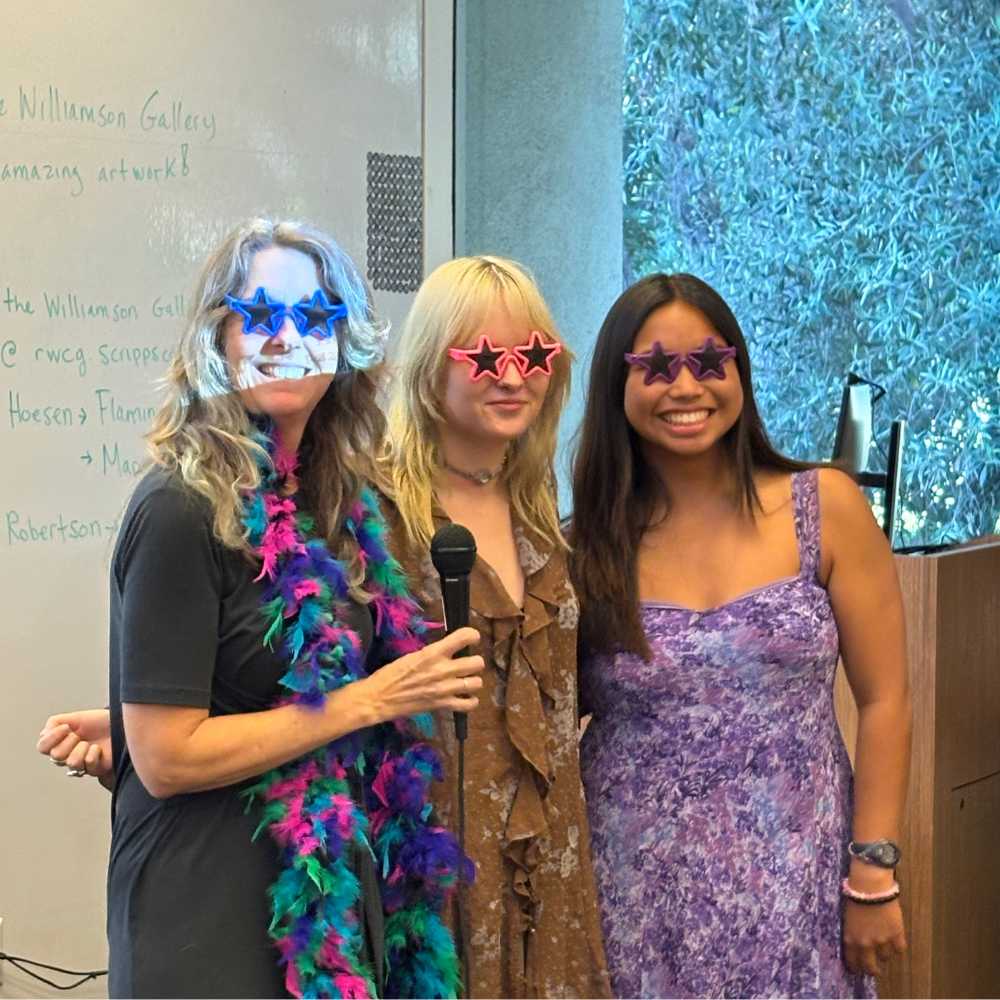
Professor of Writing Kim Drake (far left) and two writing and rhetoric students
By Tess Miller ’27
The last item on Scripps alphabetized fields of study is the writing and rhetoric major. It can slip through the cracks, misinterpreted as the same as English or creative writing. But at its core, the major emphasizes rhetorical analysis and effective communication to audiences far beyond peers and professors.
What is Writing and Rhetoric?
“The major’s foundation is nonfiction writing,” says Kimberly Drake, professor of writing and chair of the Department of Writing and Rhetoric. “It’s based on the essay, a genre that people use in journalism and in some versions of memoir, personal statements, academic writing, and even speeches.”
Lucy Jaffee CMC ’26, a writing and rhetoric major, feels the program has made her a multifaceted and adaptable communicator. “I have learned the power of words—I’m more conscious not only of the way I write, but also how I speak and listen to others,” she says.
Thinking about how to approach specific audiences, notes Drake, is something people do all the time—evidence of how we use the major’s skills without even knowing it.
“Rhetoric includes nonverbal, visual, and auditory communication. We all do this to make ourselves understood,” she explains. “Everybody has some understanding that there’s a more or less effective way to ask for a favor of your parents, for example. When you write academically, the audience is a narrow group of people.”
Majoring in Writing and Rhetoric at Scripps: Courses, Requirements, and Advice
Scripps’ writing and rhetoric major requires eight courses, along with writing studio and senior thesis. One foundational class can be chosen from three respective categories: histories of writing and rhetoric, creative nonfiction/essay/journalism, and persuasive multimodal rhetorics.
Three workshop courses are also required. “We want to make sure that everybody experiences the classic writing workshop more than twice,” says Drake. “The ability to take edits and figure out a revision strategy is done only by desensitizing yourself to getting feedback and learning to appreciate it.”
Jaffee, who has taken many workshop classes, says, “Kim has a special way of building trust among her students, making workshops effective and fun.”
Lastly, two discourse and rhetoric courses are required. These courses are included to teach students how to analyze pieces of writing, engage with writers to wholly understand their rhetorical choices, and elevate their own work.
Since the major only requires eight courses, writing and rhetoric is a perfect pairing for a dual or double major—including with fields of study that may not seem so obvious.
“Students who double or dual major in areas like science and writing will be the communicator in their field,” says Drake. “You’ll be the person in the lab who can write grants to get funding, communicate with the outside world, and help people understand how the field contributes to their lives.”
Ansley Mashuda ’27, who is double majoring in writing and rhetoric and psychology at Scripps, finds skills from both worlds apply to each other.
“Designing research studies in psychology is a lot like the way you have to convince your readers of an argument or feeling in creative nonfiction,” she explains. “Pursuing a degree in writing and rhetoric is incredibly valuable, especially considering that I’m hoping to attend law school and pursue a career in the legal world.”
The Relevance of a Writing and Rhetoric Major Today
Drake posits that the ability to communicate effectively and persuade audiences are both skills used in our everyday lives, both personally and professionally. Each time you write an email, answer an interview question, or give an elevator pitch, you are using crucial writing and rhetoric skills that are crucial for development, both in and beyond college.
After all, Drake says, research reveals that what top employers seek are exactly what her department teaches.
“Written communication is always in the top five. That’s part of the writing and rhetoric major.”