

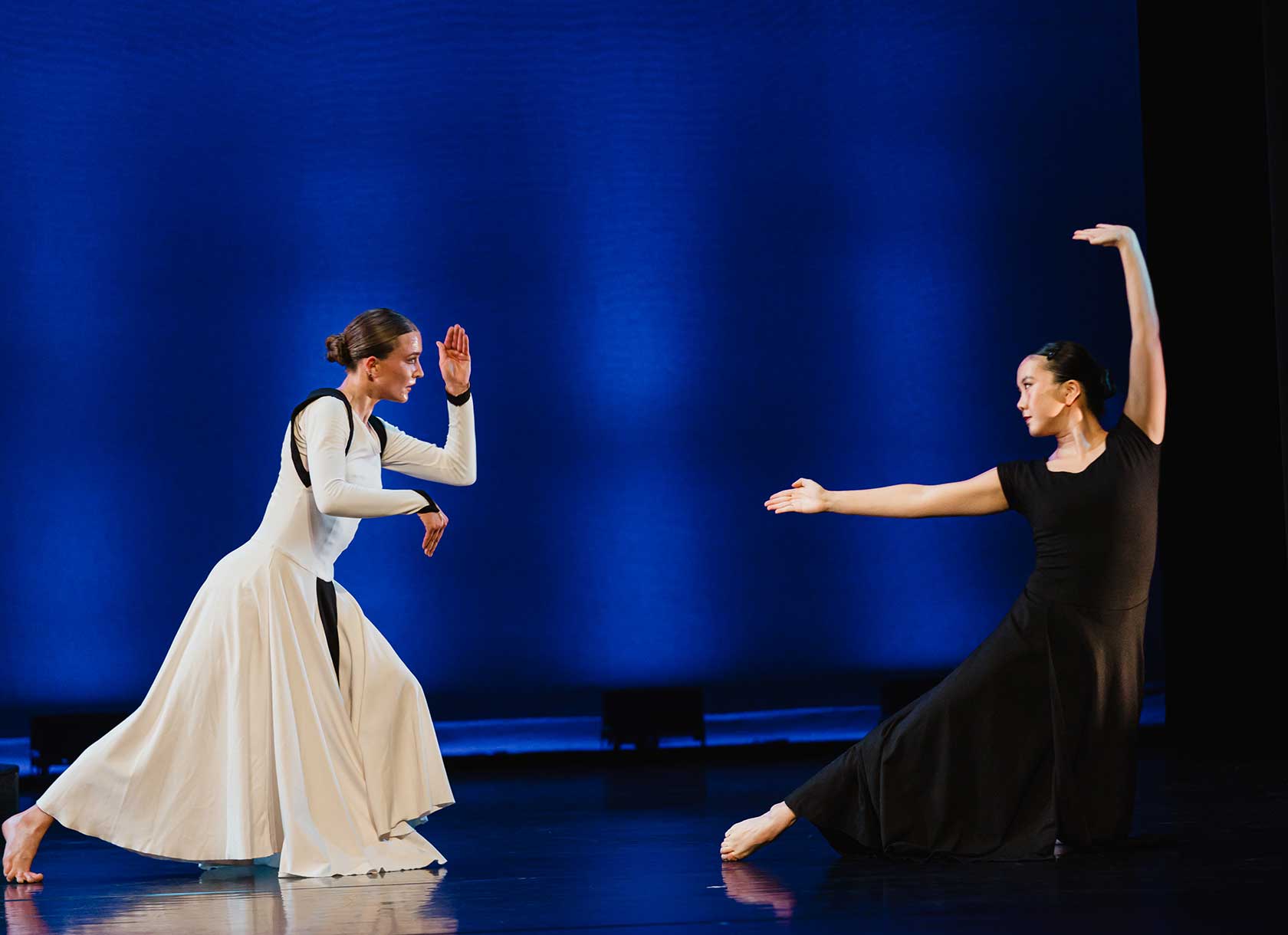
 Mia Ciotti ’26 and Audrey Che ’27, photo by Jay Williams
 By Caitlin Antonios
- Dance serves as a liberal arts practice that integrates intellectual inquiry, historical preservation, community building, activism, and personal growth, highlight through the College’s recent collaboration with the Martha Graham Dance Company for a portion of the annual Scripps Dances performance.
On a late Friday night in Scripps’ Richardson Dance Studio, 15 dancers stand barefoot in a circle. They breathe loud and heavy as they stretch, preparing their bodies for the next 20 unrelenting minutes of rehearsal for Scripps Dances, the crown jewel of the College’s dance program. Just beyond the circle, Assistant Professor of Dance Abdiel Jacobsen pounds on a djembe, a West African rope-tuned goblet drum, and clashes a small cymbal in rhythmic counts.
How does a dance performance like this come together? In part, it is the culmination of experienced eyes zeroing in on the need to gently extend a dancer’s fingertips or push a student’s chin a fraction of an inch higher during rehearsals. It is students finding mental focus amid the chaos of their academic and personal lives. It is the intentional connection of movements rooted in human sight, sound, and emotion.
On this campus, dance is not merely extracurricular expression.
It is a method of inquiry that unites intellect and body—a core ideal of the liberal arts. Its place at Scripps gives students the tools to connect to their bodies; construct a window into history; and bond with peers and people beyond their lived experiences.
Do You Feel That Buzz?
It’s one of the many prompts that educator, actor, and former Martha Graham Dance Company dancer Nya Bowman throws at the students while they stretch. She is getting them in tune with their muscles and breath, generating the energy they’ll need to unleash their movements.
“That is what you have to hold on to,” Bowman says. “You imagine the buzz; the audience sees it.”
This spring, students from across the 5Cs auditioned to be part of Scripps Dances, the College’s annual dance repertory concert. Including original choreographed works from students and faculty, Scripps Dances showcased “Steps in the Street” and “Prelude to Action”—two pieces from the Martha Graham Dance Company, the oldest professional school of dance in the United States.
Both Scripps and the dance company are celebrating their centennials in 2026; a feat their founders could have only dared to hope for. Created by and for women, both institutions now face similar mileposts as the world increasingly questions their value.
In development for two years, Scripps Dances’ collaboration with the Martha Graham Company is due largely to Abdiel, who served as the company’s highest ranking principal dancer for the better part of a decade. The performance included many guest lecturers who flew in from across the country, including movement artist, choreographer, curator, and educator Nia-Amina Minor, who partnered with Bowman to prepare students for their challenging performances; and former Martha Graham dancer O’Brien Distinguished Visiting Artist Kate Reyes and Blakeley White-McGuire, another former principal dancer with the company and author of The Martha Graham Dance Company: House of Pelvic Truth. Together, Bowman, Reyes, and White-McGuire introduced students to the Graham technique.
The Graham technique is characterized by contraction and release; sharp and deliberate shapes; grounded movement; audible breathwork; and emotional intensity. It requires not only stamina, but also extreme physicality and mental focus. The style embodies a central idea: The best way for dancers to communicate with the audience is to experience complete connection with every part of their body—or, as Bowman puts, “the buzz.”
If you’ve ever taken a Pilates class, you’ve tasted a sliver of Graham. She and the mind–body discipline’s founder, Joseph Pilates, mutually influenced one another when they met in New York in the 1930s. Like Pilates, Graham saw her medium as more than movement—it was a language to explore and exchange deeper truths.
Audrey Che ’27, a biology major with a minor in dance, is mastering that language. Since coming to Scripps, Che has joined the College’s annual fall showcase, In the Works, where students present their developing choreographed works. She was also one of the leads of Scripps Dances this spring and appeared in both Graham works.
Che plans to attend medical school after graduating next year and credits dance with helping her discover her path.
“Most of the women on my mom’s side of the family have danced, and my mom was the artistic director for a local Chinese dance group,” Che says. “It was really meaningful to dance with her throughout my childhood.”
Growing up in a predominantly White area in Kansas, Che found that dancing with other Chinese girls and connecting with their families built bonds that remain today. Before arriving at Scripps, her main dance experience came from ballet, which instilled the discipline and technique needed for her In the Works and Scripps Dances performances. Learning how movement could be medicine sparked her desire to pursue a future in healthcare—a goal she shares with her Scripps Dances co-lead, Mia Ciotti ’26.
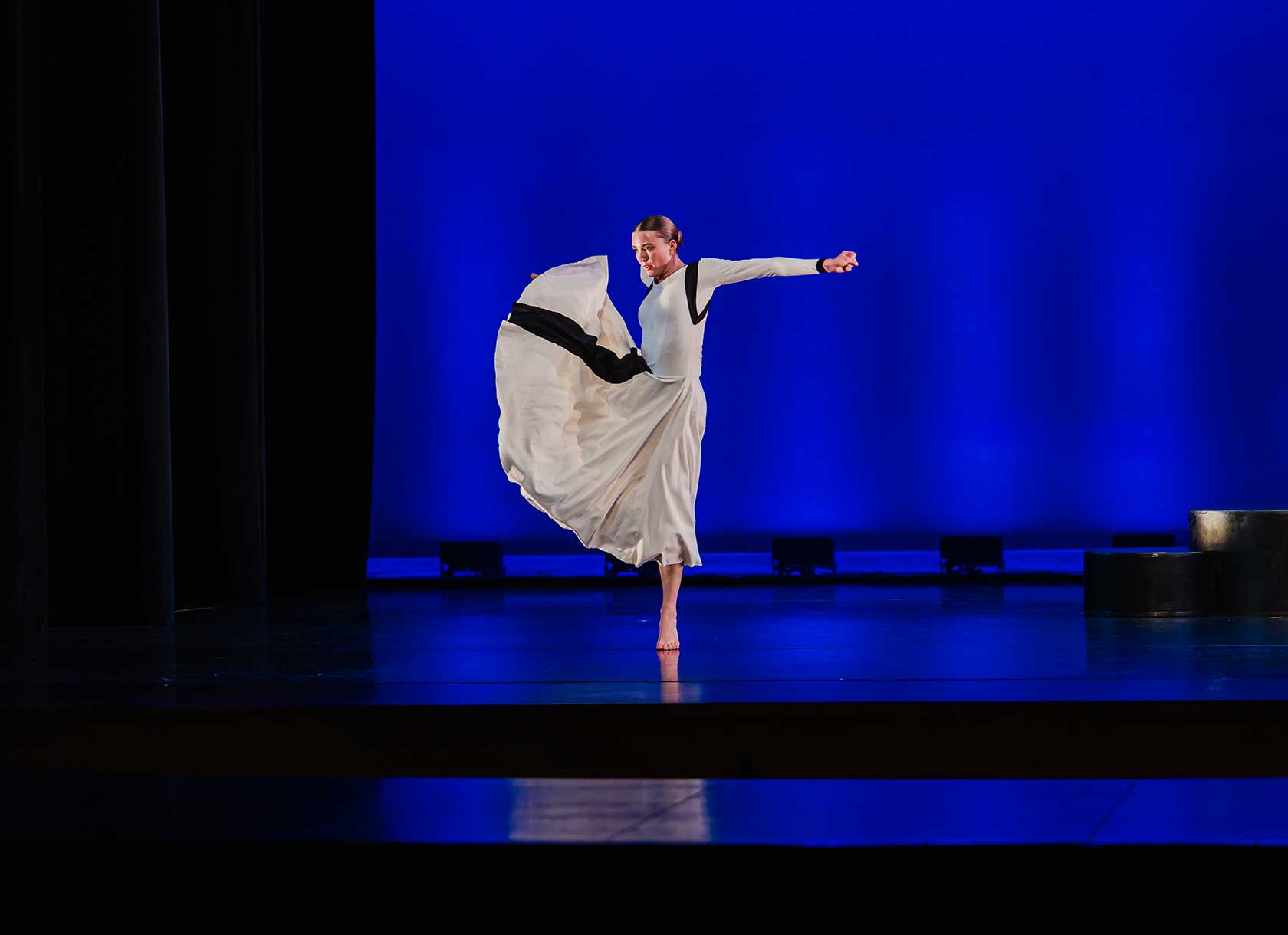 Mia Ciotti ’26, photo by Jay Williams
A human biology major on the cross-cultural health and healing track with a Spanish minor, Ciotti has also participated in many Scripps concerts. Raised in a small Colorado town with an even smaller dance community, she delighted in traveling to new places thanks to dance competitions.
“Caring for my body through dance has been a big value of mine. It gives me a strong sense of self,” Ciotti says. “Dance has made me want to learn about healing, especially its diverse forms, and the cultural histories behind healing systems.”
Like Ciotti, Sarah Hansen ’27 describes her experience with Scripps’ dance community as a form of recovery. Prior to performing in both Graham pieces this year, she had studied ballet for years—yet early discontent with her experience fueled a desire to attend a women’s college and pursue research in both dance and history. Today, she is majoring in both at Scripps with a feminist, gender, and sexuality studies minor.
“Growing up, I didn’t have a lot of queer representation for women in ballet. I always felt like there was something wrong with me, or like I wasn’t a good enough dancer because I was queer,” she says. “Being part of the Scripps Dances chorus truly feels like a movement of people together.”
Che, Ciotti, and Hansen agree that dance has pushed them to greater achievements, both academically and professionally.
“Dance speaks to a liberal arts education. We can be biology majors and the leads of a major artistic production,” Che says.
Hansen notes that Scripps Dances perfectly embodies what she loves about her chosen fields of study.
“[The show] creates a beautiful avenue for dancers to talk about what’s happening in the world,” Hansen says. “When I’m performing, especially ‘Steps in the Street,’ I envision when it was performed in the 1930s and again in the 80s. I ask myself, ‘What historical moments made those dancers perform that way? What were they frustrated by, curious about, or reflecting on?’”
Heels Off the Floor: Activating Resistance Through Modern Dance
In the dance world, Martha Graham and her company are iconic—and while awareness of her among the general public may be niche, her influence on artists is not.
The “Queen of Pop,” Madonna, trained under Graham in the late 70s. In a 2019 interview, Madonna called Graham her muse and inspiration growing up.
“Before her, there was classical dance: corsets and tutus and point shoes. Everything was covered and erect and poised and beautiful—but mechanical,” she said in the interview. “To me, she was a rebel.”
This shift was more than an aesthetic change. As John Martin, the first dance critic for The New York Times, put it in his 1989 book The Modern Dance, Graham’s take on contemporary dance “set itself positively against the artifice of classic ballet, making its chief aim the expression of inner compulsion.”
The two Graham pieces performed in Scripps Dances are part of a larger body of work titled Chronicle, which premiered in New York City in 1936. Before its debut, Graham had been invited to perform at the Olympic Games, which were hosted in Germany that year. She refused in defiance of Nazi Party leadership—an “inner compulsion” that led her to compose the piece in direct response to European fascism ahead of World War II.
Chronicle was originally five sections. The company has reconstructed three, while two remain lost to history. The pieces seek to portray the spiritual devastation of conflict and the persistence of hope. Such rebellion has long been communicated through books, poetry, or rousing speeches. Yet dance’s storytelling power is decidedly visceral.
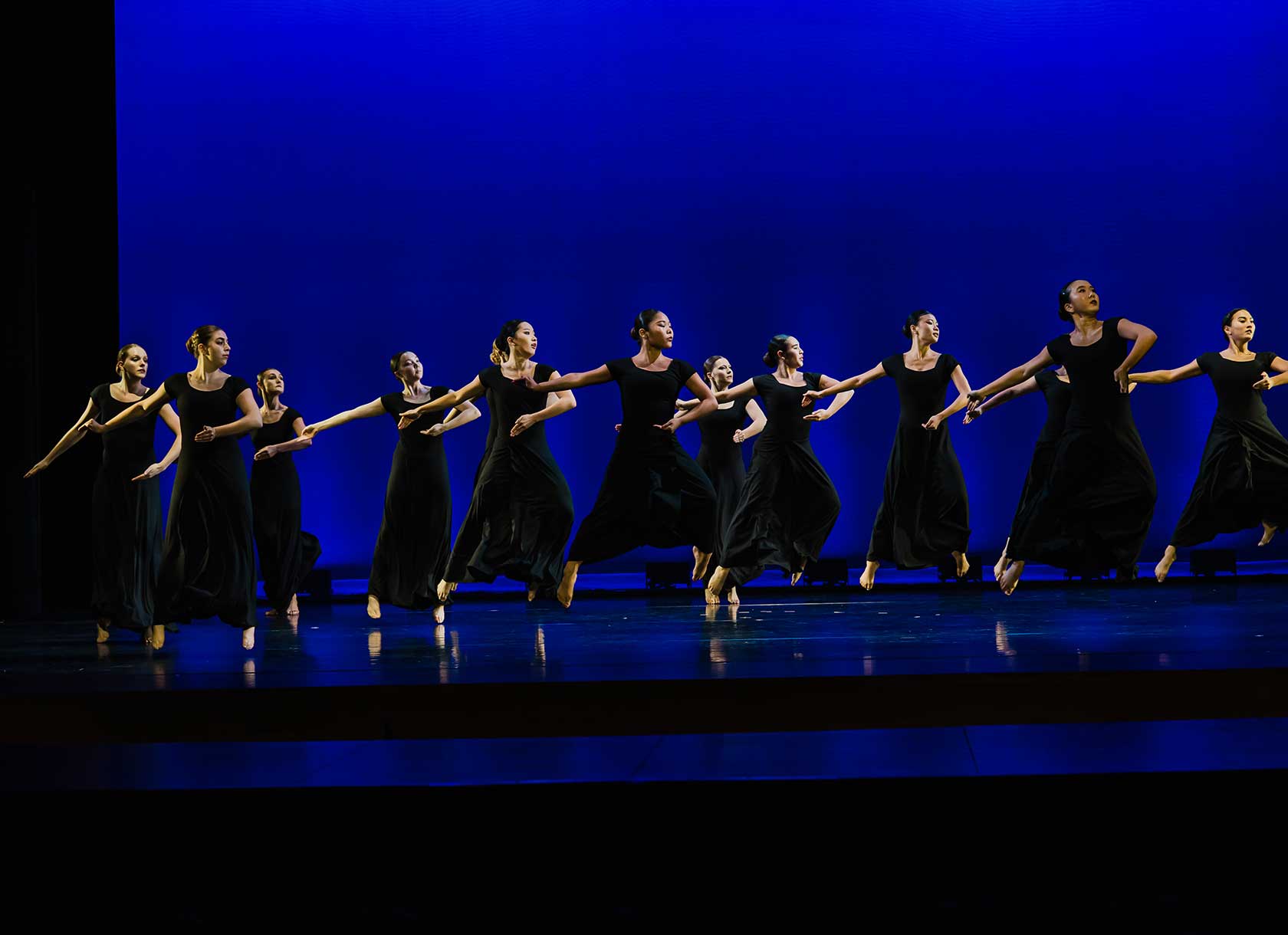
At roughly the midpoint of “Steps in the Street,” Scripps’ lead Che stands alone, slowly expanding her body outward while lowering to the floor. The chorus dancers walk in a line behind her. When the line ends, Che powerfully swings up from the floor to join them. Part two sees Ciotti begin the piece alone, elevated on a three-step platform. Members of the chorus appear as the music swells. As Ciotti descends the platform, she embodies hope as resistance—rising above in pursuit of a better tomorrow, a feat she can only accomplish because of the others around her.
The unending cycle of political and humanitarian crises keeps dance relevant as a form of commentary. In her first workshop with students, Bowman shared that she first performed “Steps in the Street” in New York City in the wake of the 9/11 attacks. Rehearsals for the show—a portrayal of the power of community—took place as the United States’ conflict with Iran and deportation of immigrants within the country escalated.
But dance is a mechanism for more than geopolitical critique. While auditions for this year’s Scripps Dances welcomed 5C students of all gender identities, Scripps’ cast ended up featuring all women—just like Graham’s original show.
In creating their respective institutions in 1926, Martha Graham and Ellen Browning Scripps achieved monumental progress for women—right on the heels of what has been labeled as a “feminist void.” Following the Great Depression, which lasted from 1929 to 1939, women organized less and re-engaged traditional gender roles for the sake of family survival. Julia L. Foulkes, author of Modern Bodies: Dance and American Modernism from Martha Graham to Alvin Ailey, argues that dance until this period followed suit, primarily centering women as spectacle for the male gaze. Yet Graham’s simultaneous emergence cut that narrative.
“Modern dancers challenged this convention by displaying different visions of women on stage with the purpose not of titillation, but of defiance and demand,” Foulkes writes. “Modern dance changed what was on stage, who was in the audience, and the expectations of the audience.”
Don’t Come Forward, Go Up
In celebrating dance as a mode of inquiry and activism, it can be easy to overlook the tensions embedded in its past. But for artists like Abdiel (who uses they/them pronouns), the solution emerges from the problem itself: Dance can preserve history even as it interrogates it.
Abdiel is the driving force behind this year’s Scripps Dances and its collaboration with the Martha Graham Dance Company. Their eight-page résumé includes performances with dozens of companies across the globe as well as extensive research, competitions, awards, and teaching experience. While Graham is part of their journey, Abdiel’s current scholarship is focused on Latin Hustle—its creative evolution, queer lineage, and historical preservation.
At a recent Collegium for African Diaspora Dance conference at Duke University, Abdiel presented their research through the lens of Black “phoenixing” and how it relates to Latin Hustle. It’s context they intentionally weave into their dance courses at Scripps.”
“The generation of people who created this dance form were teenagers in the 1970s,” Abdiel says, noting how its first purveyors were impacted by everything from the Vietnam War to the Civil Rights Movement to the AIDS epidemic. “Through community, this dance emerged, modeling a shared voice that meets resistance and rises from the oppressive ashes.”
Prior to joining Scripps, Abdiel was awarded a Dance/USA archive fellowship in recognition of their graduate study’s oral history research on Latin Hustle. The fellowship strengthened their archival practice, supporting the collection of community artifacts and partnerships with institutions such as the Center for Puerto Rican Studies (CENTRO) at Hunter College and the Caribbean Cultural Center African Diaspora Institute (CCCADI). Their work now extends to Dance Is Life, the organization they co-founded, as a key site for preserving the cultural and historical legacy of Latin Hustle.
“We found flyers and scrapbooks that center the Latino contribution and formation of this dance that was later erased through whitewashing and mass commercialization,” Abdiel explains.
For those who “aren’t that into dance,” Abdiel argues that physical movement is a critical form of historic preservation that anyone can value. In practice, respect for the medium can even bridge cultural differences.
“Dance was a sanctuary. It was their way of dealing with resistance and oppression,” Abdiel says. “You may not have that connection to the dance, but it’s important to understand that could be a possibility for someone else.”
Necessary Reflection
While dance has liberated some, it has sublimated others.
When ballet legend Misty Copeland came to Scripps in spring 2025, Abdiel moderated the conversation, with students showing up in droves. Copeland addressed becoming the first Black principal dancer for the American Ballet Theatre in its 75-year history—a first that Abdiel well understood. Together, they discussed the challenges, burden, and power of being “the only” in a room.
In recent years, artists have continued to confront dance’s complicated past. Before guest lecturing at Scripps, Nia-Amina Minor co-founded Black Collectivity, a collaborative project exploring how the body carries memory and culture. In the global racial reckoning that followed the 2020 murder of George Floyd, former Martha Graham dancers began speaking out about their own difficult experiences with the company. In response, Nya Bowman— the company’s first Black woman to dance the iconic solo in Lamentation, an exploration of grief—is one of the founders of the Martha Graham Alumni Antiracist Alliance, created to address inequities in pursuit of healing.
Holding meetings to help members engage in antiracism work, the Alliance, which is not officially affiliated with the company or Graham dance center, invited dancers to bring Martha Graham quotes to life through choreography. Abdiel created a video with former Graham performer Stacey Kaplan, narrating a Graham quote through dance: “All that is important is this one moment in movement. Make the moment important, vital, and worth living. Do not let it slip away unnoticed and unused.”
Stay in the Power of the We
At Scripps, understanding dance’s past and role in social activism is essential to grasp its current purpose. Abdiel, who identifies as a queer, genderfluid person of color, intentionally brought Minor and Bowman to Scripps during Black History Month to unpack this context with students—even as they mastered Graham’s choreography. In positioning dance as more than “memorizing steps,” Abdiel continues to use the medium to provide platforms and curate spaces for other underrepresented people at—and beyond—the College’s gates.
But how is that done practically? On campus, the space curation is literal: Next year, the new Carolyn Lake Dance Center will officially open. Expanding the College’s capacity for teaching, rehearsal, performance, and community-building, the modern building represents decades of academic and philanthropic labor by those who uphold dance as vital to the Scripps experience.
For Abdiel, progress involves resisting the urge to place a person or institution on an untouchable pedestal. It’s saying, “thank you,” and acknowledging the work that remains to be done.
“I danced with Martha Graham for a long time and I have these relationships, but there’s trauma in that, too,” Abdiel says. “We need to evolve in our conversations. There is complexity and nuance in every person’s life, [but] when we revisit these moments of deep legacy, it is important to hold space for it all. Not just the good.”
These are the connective tissues that make dance such a powerful branch of discipline. Its ability to ask questions, preserve complex history, and incite humane action can be a balm to the world’s harsh realities. It’s reconciliation not performed as a solo act, but through collective movement.
In the introduction of her book, Foulkes writes, “this tension between individual identity and communal harmony lay at the core of the new modern dance.” Through dance, Scripps’ centennial allows us to examine what to illuminate for the next 100 years.
Bowman’s advice to students during her Scripps Dances workshop offers a clue.
“This is what this piece demands: community. Think of the ancestors who got you here. You’re touching, you’re here with your friend,” she said. “Stay in the power of the ‘we.’”