

By Erin M. Curtis, Director of the Ruth Chandler Williamson Gallery
- Scripps College celebrates its deep connection to pioneering artist Betye Saar—whose influential career, family legacy, and longstanding relationship with the College reflect a shared history of artistic innovation, Black cultural expression, and mentorship across generations—as they each celebrate their own 100-year milestones.
As Scripps College enters its second century in 2026, it will be joined by one of Los Angeles’s most influential artists. Betye Saar—mother of Scripps alum and artist Alison Saar ’78—will turn one hundred this July, a milestone that invites reflection on her life, visionary practice, and connection to Scripps.
Born in Los Angeles and raised in Pasadena, Saar studied design at the University of California, Los Angeles. She graduated in 1949 and quickly founded an enamel business with jewelry designer Curtis Tann, which was featured in Ebony, the iconic magazine dedicated to Black culture, in 1951. Graduate school printmaking classes shifted her career, and she began to create prints evincing an interest in mysticism.
Scripps is fortunate to hold some of Saar’s works at the Ruth Chandler Williamson Gallery. The Mystic Elements (1966) demonstrates her fascination with sacred iconography, showcasing astrological symbols and representations of earth, air, fire, and water. The dense layering of images and complex construction became hallmarks of her later work.
Saar began combining her prints with found objects. Alongside LA-based Black artists like John Outterbridge and Noah Purifoy, Saar shaped the dynamic medium of assemblage, which combines three-dimensional elements (often found objects). In the assemblage work Hoo Doo Lady with Three Dice (1977), Saar reclaims a racist caricature of Black women by surrounding it with a constellation of symbols, transforming derision into exaltation.
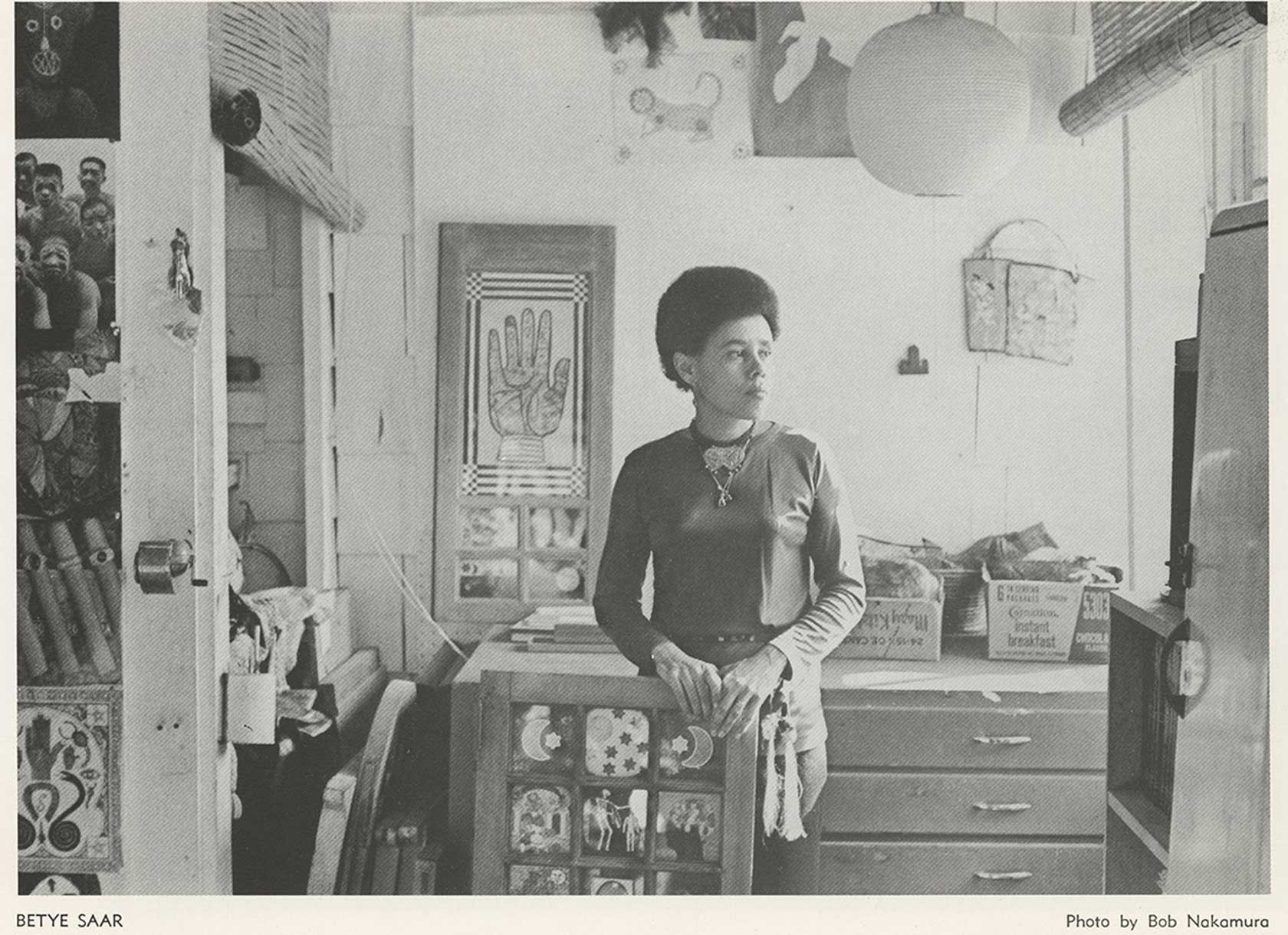
In 1970, artist, scholar, and Scripps’ first tenured Black professor Samella Lewis curated the exhibition 5: Benny, Bernie, Betye, Noah & John at the College, featuring works by Saar alongside Outterbridge and Purifoy as well as artists Benny Andrews and Bernie Casey. In the show’s pamphlet, Saar is pictured in her Laurel Canyon studio, holding her famous work Black Girl’s Window (1969) with a provocative caption: “The window is a symbolic structure From the Archives which allows the viewer to look into it to gain insight and to traverse the threshold of the mystic world.”
Eight years later, Alison Saar ’78 graduated from Scripps with a degree in art history, studying Black visual traditions under Lewis that inspired her own artistic career. Today, the College’s collection includes works by Samella Lewis, Betye Saar, and Alison Saar, most recently appearing in Gettin’ It Done, a 2023 exhibition of works by eight Black women that the Gallery’s former collections manager and registrar Kirk Delman organized to honor Lewis’s life and legacy. Betye attended the exhibition and saw The Mystic Elements on display—a poignant convergence of histories as inextricable as the four elements: Betye, Alison, Samella, and Scripps.