

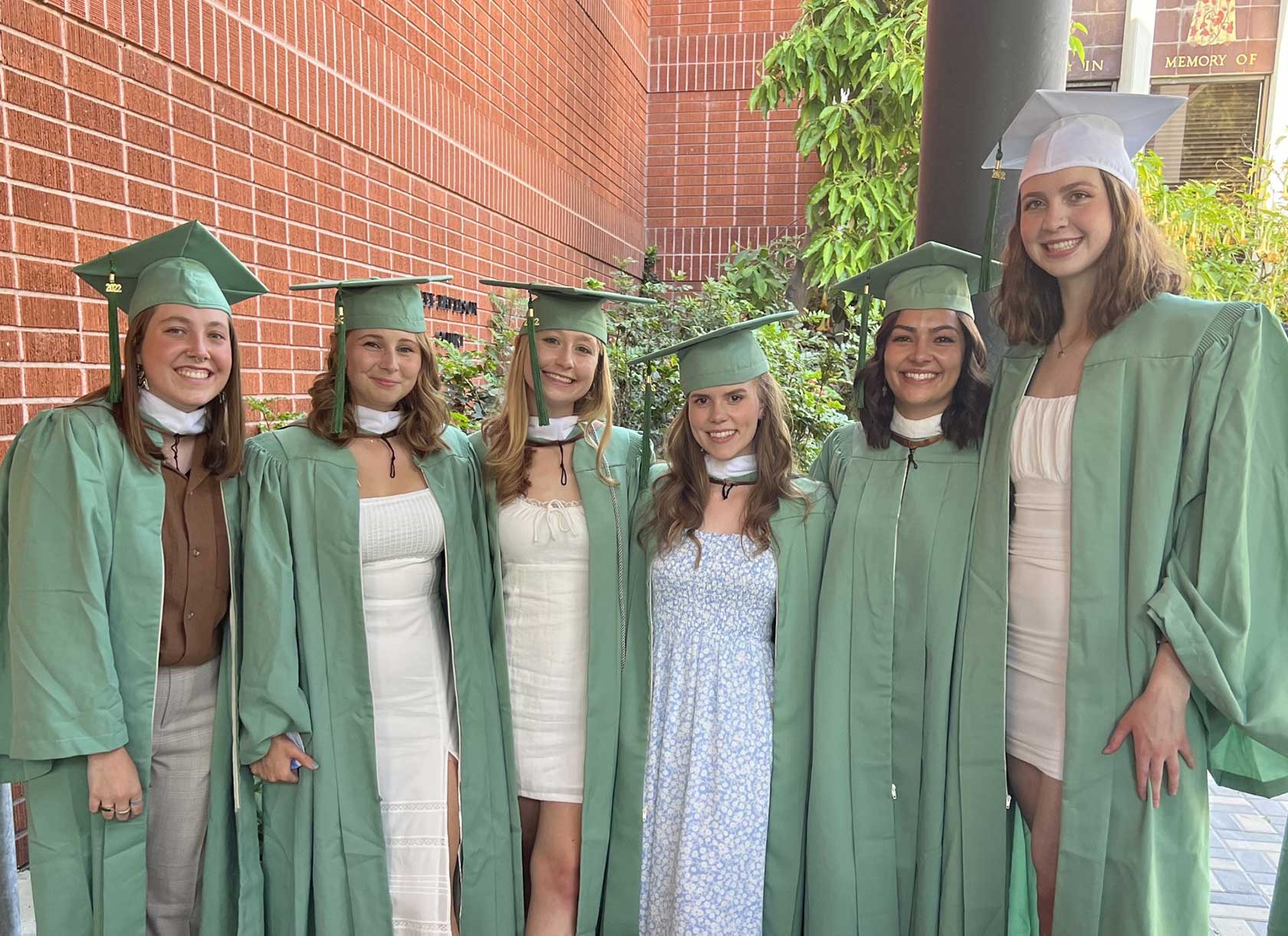
Molly F. Lazarus ’22 (center) with friends at Scripps College’s Commencement
By Kendra Pintor
- Molly F. Lazarus ’22 credits Scripps’ interdisciplinary liberal arts education and hands-on undergraduate research opportunities with launching her path to a Harvard PhD in cognitive neuroscience and earning the prestigious National Science Foundation Graduate Research Fellowship.
When Molly F. Lazarus ’22 arrived at Scripps College, she did not expect to become a cognitive neuroscientist. Like many liberal arts students, she was drawn to Scripps, where she was free to explore her interests before choosing a path. She came with broad academic interests and a love of learning, eager to take advantage of a curriculum that encouraged curiosity across disciplines.
That openness led Lazarus to psychology and to questions that now shape her doctoral research: how early experiences influence physiology, brain development, long-term health, and behavior. Through coursework at Scripps and across The Claremont Colleges, she encountered the idea that experiences—especially those in early childhood—do not simply become memories. They can become biologically embedded, shaping the developing brain in lasting ways.
“Looking back, I can trace a direct line from those first classes at Scripps to the work I do today as a PhD student at Harvard,” Lazarus says.
Now a Harvard PhD student in the Laboratories of Cognitive Neuroscience, Lazarus studies how brain and behavior develop across childhood and beyond. Her current work builds on the interdisciplinary foundation she began forming at Scripps, where discussion-based classes, close faculty relationships, and access to research opportunities across the consortium helped her discover the kind of questions she wanted to pursue.
The Scripps Difference
During her sophomore year at Scripps, Lazarus joined the AMH-CARE Lab, a collaborative research lab between Pomona College and Claremont McKenna College. There, she discovered how much she loved research—and how distinctive the undergraduate research experience can be at a small liberal arts institution. Rather than contributing to only one small piece of a larger project, Lazarus grew into one of the senior members of the lab by her junior and senior years.
That role gave her meaningful responsibility: collecting and analyzing data, helping develop research questions, mentoring newer students, presenting at conferences, and contributing to manuscripts. Because Lazarus attended Scripps, a member of The Claremont Colleges, she had access to the AMH-CARE Lab and valuable learning experiences that prepared her for the demands of graduate-level scholarship.
In addition to the consortium, Scripps touts a 91 percent acceptance rate for Scripps pre-health students to medical, dental, and nursing schools—more than double the national average. Lazarus’ journey is a testimony to the power of Scripps’ interdisciplinary liberal arts education, and that curiosity, persistence, and confidence are just as important as technical knowledge.
The National Science Foundation Graduate Research Fellowship Program
Lazarus’s preparation and research vision were recognized with the National Science Foundation (NSF) Graduate Research Fellowship Program (GRFP), a highly competitive program that supports outstanding graduate students pursuing full-time, research-based master’s and doctoral degrees in STEM fields. For Lazarus, the fellowship represents both validation and momentum at a formative stage in her academic journey.
“Receiving the NSF Graduate Research Fellowship is an incredible honor and something I am deeply grateful for,” she says. “On a personal level, it is incredibly meaningful to have a research vision that I have been developing over many years recognized by the NSF.”
Graduate school, Lazarus notes, requires much more than mastery of a subject. It asks students to evaluate evidence critically, communicate complex ideas clearly, and approach problems from multiple perspectives. The liberal arts curriculum at Scripps helped her cultivate all three.
Equally important was the community Lazarus found at Scripps. Some of her closest friendships today began during her undergraduate years, and the support of those peers continues to shape how she navigates the uncertainty and challenge of graduate school.
“Having such an incredibly kind, supportive, and accomplished group of women behind me has given me the confidence to pursue opportunities that once felt intimidating,” Lazarus says. “That sense of support has made me more willing to take risks, and I think it is one of the most valuable parts of my Scripps education.”
Lazarus’ Advice for Current Scripps Students
For current Scripps students who are interested in research, fellowships, or graduate school, Lazarus offers advice grounded in her own experience: do not be afraid of failure or rejection. In research, she says, setbacks are not the exception—they are part of the process. Papers may be rejected, grants may be declined, experiments may stall, and analyses may not unfold as planned.
Rather than treating those moments as reflections of ability or worth, Lazarus has learned to see them as opportunities for growth.
“Some of my biggest growth as a researcher has come from projects that didn’t work the first time or opportunities I didn’t initially receive,” she says. “If you’re genuinely curious about the questions you’re asking, despite the setbacks, you’ll keep moving forward.”
Give Today! We are proud to announce Scripps Forward: The Centennial Campaign for Scripps College. Over the next three years, our goal is to surpass $100 million in donor support to secure a future of infinite possibility for the next century. As we continue to attract a growing pool of top talent, your support ensures that these students—regardless of their financial circumstances—can fully engage in Scripps’ academic and co-curricular life. Thank you for your generosity!