

 Photo courtesy of Theo Perlin
By Caitlin Antonios
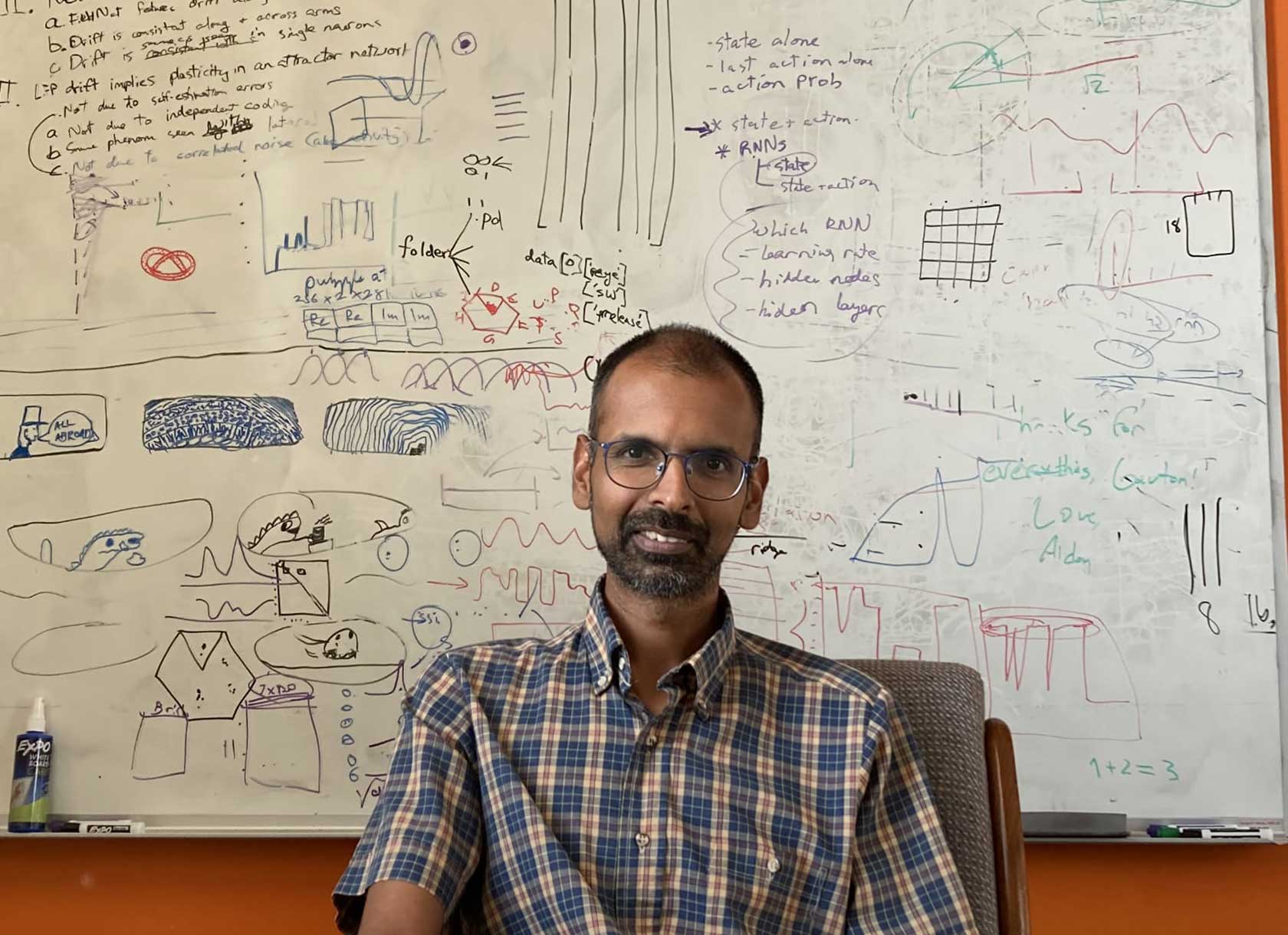
- New research from Assistant Professor Gautam Agarwal’s beatLab shows that weak brain waves contain meaningful information about memory and location, opening new avenues for neuroscience research.
It’s natural to pay attention to the biggest changes when looking at brain activity. But in recent research conducted by the beatLab, headed by Assistant Professor of Neuroscience Gautam Agarwal, raises the question: What can the weaker activity tell us?
In a new paper published in Nature Communications, Agarwal and his colleagues study this question in the hippocampus—the part of the brain that forms and retrieves memory. They studied activity generated by large groups of synchronized neurons, sometimes called “brain waves,” and developed a way to read out these waves even when they become weak and unreliable. The findings open the door to examine previously overlooked patterns of brain activity.
“In science, we historically focus on the loudest signals,” says Agarwal. “Often, there are much more subtle differences that carry meaning.”
Dare to ask
Agarwal has been part of the Scripps and Pitzer Colleges’ Department of Natural Sciences for five years. His research focuses on how human problem-solving differs from that of artificial intelligence (AI), the surprising information that brain waves carry, and how neuroscience interfaces with other practices to improve quality of life.
In his research group’s latest publication, collaborators measured brain activity from rats running through a maze. The rats spent time drinking water at the end of a maze, a condition that produces more “noise” in the form of irregular brain waves.
In science, we historically focus on the loudest signals. Often, there are much more subtle differences that carry meaning.
The weaker, more noisy waves were also found when the rats were allowed to roam free. The group’s finding that weaker activity can still reveal location-related information means that even when strong brain rhythms aren’t available, information can still be gleaned when analyzed appropriately.
Precision in biology is difficult because there’s a lot of noise, Agarwal says. It’s like an orchestra in which the musicians can choose to depart from the guidance of the conductor. The full song may initially capture your attention, but then you can start to examine the details of different musical lines.
“You can’t assume the conductor has the final say,” Agarwal says. “You have to look at the instruments directly.”
Reinvigorated by teaching
For Agarwal, the journey to academia came at the encouragement of those closest to him.
“When doing research as a postdoc I was often banging my head against a metaphorical wall and felt drained much of the time,” Agarwal says. “But when I was teaching, people in my life noticed how energized I was.”
At Scripps, he’s found inspiration in being with students who are determined, ambitious, and know what they want out of their educational experience. The National Science Foundation ranks Scripps among the nation’s top predominantly undergraduate institutions that produce future PhDs in STEM—a testament to Scripps’ hands-on research and close faculty mentorship.
Agarwal also enjoys bringing his extensive research experience into the classroom.
In his class on modeling behavior, students explore foundational works in neuroscience, how experiments and models have evolved, and where current research fits in. That context gives students a better understanding of where their own curiosities can take them in uncharted STEM territory.
“There’s a lot of data now available online, which is useful for a liberal arts college,” Agarwal says. “It levels the playing field because we’re using the best datasets when doing our own research. We can go really deep in our classes.”